

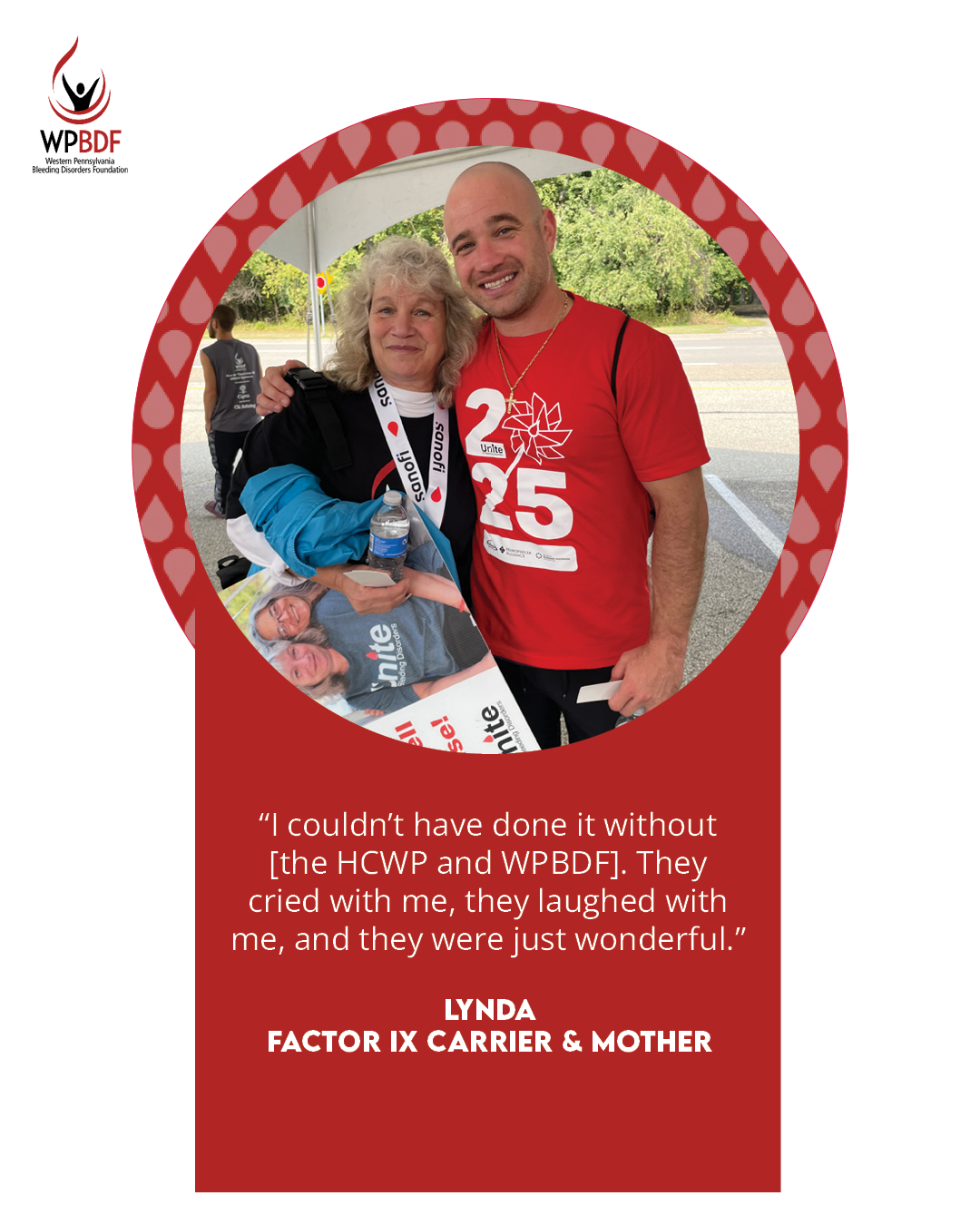
Lynda is the mother of two boys, who were born just 15 months apart. Her first son didn’t show any signs of a bleeding disorder when he was born, but once he began crawling, strange bruises began appearing all over his body.
With no known family history, doctors suspected leukemia, but further testing confirmed his diagnosis of Hemophilia B.
“It was devastating,” Lynda said. “I couldn’t even say the word.”
Because of her oldest son’s diagnosis, the doctors tested her second son as soon as he was born and he received the same diagnosis. Then, Lynda found out she was a carrier of Hemophilia B. A hemophilia carrier is a woman who possesses a mutated gene on one of her two X chromosomes. Carriers have a 50% chance of passing the gene onto their son or daughter. While some carriers have factor levels within the normal range and may not experience symptoms, others have lower factor levels and can have bleeding symptoms, such as heavy menstrual bleeding, easy bruising, or prolonged bleeding after injuries or procedures
To this day, Lynda still isn’t sure where this genetic condition came from. Both her and husband’s family tested negative for a bleeding disorder, so learning that she was a carrier of Hemophilia B was incredibly difficult. “I felt guilty because I gave my children this,” she said. “You carry that guilt for a long time.”
Lynda became hyper-aware of every movement, every bruise, and every potential risk while her sons grew up. Her sons wore helmets decorated with Barney and Power Ranger stickers, she sewed knee pads into their clothes, and she covered them in Sharpie to track their bleeds. Looking back, she admits she may have been a bit overprotective, but she needed it for her own peace of mind.
The emotional toll of the diagnosis, combined with the demands of caregiving, led Lynda’s own mental health to decline for many years. Still, she emphasized that knowing about the diagnosis was better than not knowing and is extremely grateful for the support of the Hemophilia Center of Western Pennsylvania (HCWP) and the Western Pennsylvania Bleeding Disorders Foundation (WPBDF).
“I couldn’t have done it without them,” she said. “They cried with me, they laughed with me, and they were just wonderful.”
Through support groups and community events, she found both practical guidance and emotional reassurance. These networks helped her learn how to manage the condition and navigate daily challenges, while also reducing the isolation many caregivers experience. This education and support helped Lynda and her husband give their sons a childhood that was both safe and as normal as possible. They never wanted to keep them in a bubble. They promoted activities and sports as much as they could to help the kids physically and mentally. Now grown, Lynda is happy to see her children living life on their own terms, no longer defined by a diagnosis that once shaped everything.
“They do a lot of things they shouldn’t do, and things that worry me,” Lynda said with a laugh. “But I’m their mom, I’ll always worry.”
Since her sons were diagnosed more than three decades ago, treatment options for hemophilia have improved significantly. When her children were young, treatment often required multiple infusions per week. Today, many patients can manage their condition with less frequent and more effective therapies.
“There’s been so many advances,” she said. “It’s a different lifetime now. They’ve improved 100%.”
For Lynda, those advancements represent both relief and reflection. “I’m so happy for families now,” she said. “Life is such a better place for them.”
Now, nearly three decades after receiving their diagnosis of Hemophilia B diagnosis, Lynda is learning to do something she spent most of her life putting off, taking care of herself.
“For years, I didn’t,” she said. “All I did was care about the boys.”
She is beginning to reclaim parts of her life that were once set aside. “It’s finally like I’m moving upward,” she said.
Lynda’s story is a reminder that behind every diagnosis is a family learning to adapt, and the first step toward better outcomes is simply knowing where to begin.
You can make a lasting impact for families just like Lynda’s by supporting WPBDF today. Your donation will provide education and community at every stage of life, reminding affected individuals and families that they are not alone in their diagnosis. Donate today at: https://wpbdf.org/donate/