

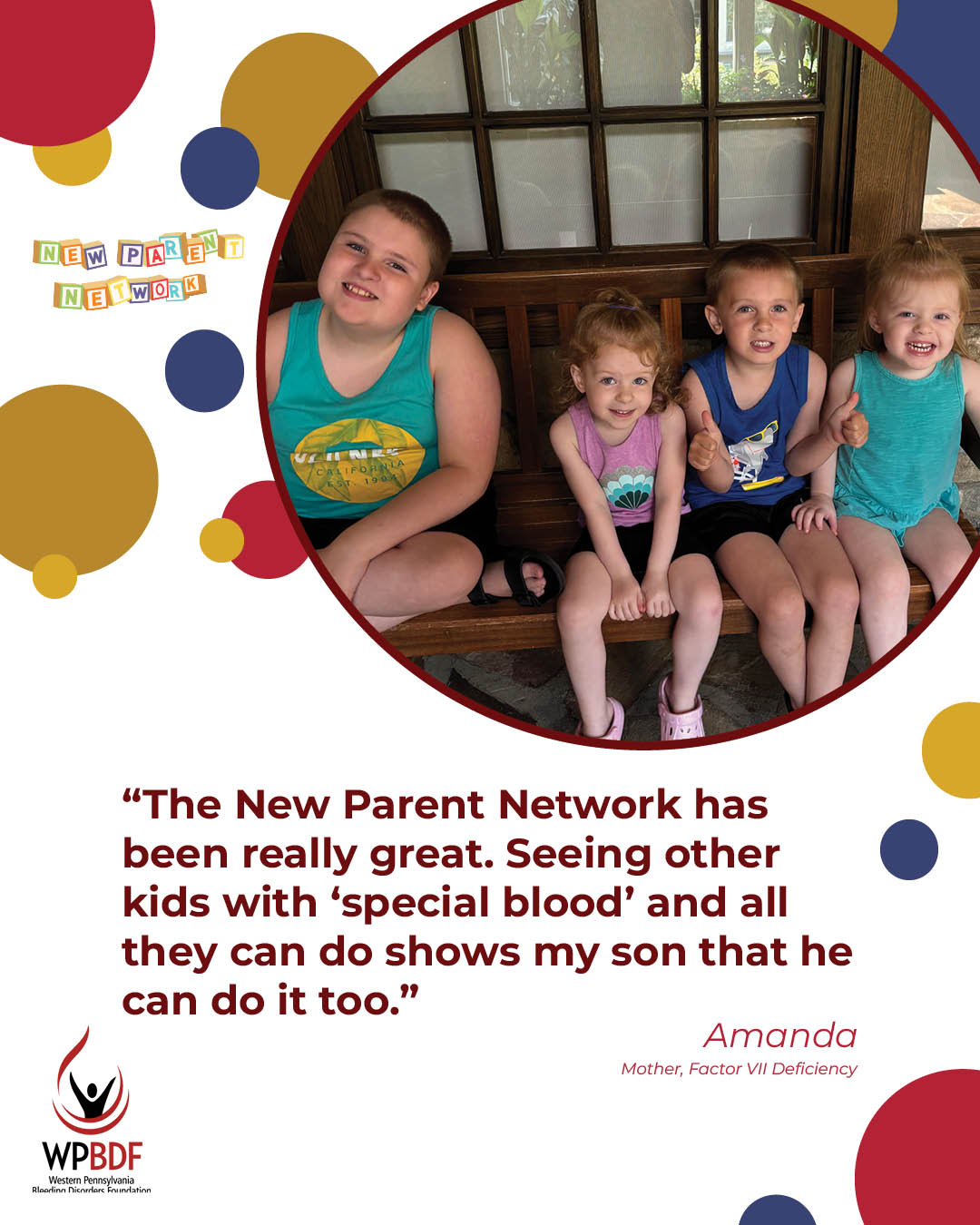
For Miles, a bright, active five-and-a-half-year-old with a rare bleeding disorder, bruises come with the territory; especially now that he’s playing baseball and soccer. From knocking faces and getting black eyes, to running into the goalpost, moments like these remind his mom, Amanda, that while she can’t prevent every bump or bruise, she can help her son live fully, confidently, and joyfully, just like any other kid out there on the field. For Amanda and her family, learning how to empower their child about his diagnosis took time and support from the Hemophilia Treatment Center, the Western Pennsylvania Bleeding Disorders Foundation (WPBDF), and the peer support found through the Foundation’s New Parent Network.
Amanda is the mother of four kids, three of which have a rare bleeding disorder called Factor VII Deficiency. Her family didn’t find out about their diagnosis through her oldest son, but through her younger son at the time, Miles, when he was 7 weeks old. It was a surprise, Amanda recalls, because they originally took him to the emergency room for the flu, not anything bleeding related. As the medical staff were trying to treat Miles, they noticed abnormal results in his blood work, specifically his bleeding response time. It wasn’t until 8 months later they received Miles’ diagnosis, and the hospital referred them to the Hemophilia Center of Western Pennsylvania. From there, Amanda’s oldest son, Griffin, received his bleeding disorder diagnosis, and when she gave birth to her twins, they were both tested as well.
“It really threw us for a loop. When you say bleeding disorder, everybody immediately panics and thinks of the Russian royal family… Like, are we related to Queen Victoria? Like, what is this,” she joked, recalling conversations with her mom and her husband. At the time of Miles’ diagnosis, neither Amanda nor her husband, Jim, knew of any bleeding disorders diagnosis in their family. She didn’t have any grasp on what this bleeding disorder diagnosis meant for her family and immediately jumped to the internet.
“You Google Factor VII and find it’s one of the rare bleeding disorders, and we thought rare means harder to access care. Rare means not as many educated professionals. Rare means you’re alone.”
Their first appointment at the Hemophilia Center of Western Pennsylvania completely changed their perspective. While Amanda and Jim felt like their world had been turned upside down, the team there was calm and confident. In that moment, what had felt terrifying suddenly became manageable.
Amanda’s first event with WPBDF was a New Parent Network social gathering held at Idlewild in Ligonier, PA. This support group is a collaboration between WPBDF and the Hemophilia Center of Western Pennsylvania (HCWP) that provides support to families who have a child with a bleeding disorder, from their child’s birth to age seven. Throughout the year, families can take part in a series of educational events that focus on topics such as preparing for emergency situations, helping young children understand their bleeding diagnosis, and more. Parents who have children with bleeding disorders are on a different journey than the one they may have initially expected, and like Amanda, can feel isolated and overwhelmed with feelings of panic, denial, fear, guilt, sadness, anger, and anxiety.
Through the New Parent Network Program, parents can find reassurance and optimism by connecting with experienced parents, teens, and young adults who share their personal stories of thriving with a bleeding disorder. The resources and support provided by this program help ensure that children and families build a strong foundation of care and are equipped to advocate effectively for their needs.
“Being part of the New Parent Network has been really, really great. The other kids are really having an impact on Miles… For him, it’s seeing the other kids that have special blood and look what they can do,” Amanda says, clarifying that special blood is the families nickname for his bleeding disorder. “If they can do that, it means I can do that. The last program that was at the Children’s Museum was superhero themed, highlighting superhero blood as your superpower. Miles got to color himself as a superhero and, you know, kind of lean into that realm of it. And like, oh, the other kids are superheroes too. And their blood does a weird thing like mine does. And they’ve got bruises and it’s fine that I have bruises because they have them too.”
Miles is incredibly social, always wanting to be friends with everyone, but Amanda has noticed he sometimes compares himself to classmates or teammates. From spring to fall, his legs are covered in purple and brown bruises, and he gets self-conscious when other kids point them out on the playground or if she or her husband comes to take a look and feel the bruises.
“Him being around the other kids has been so important, and probably within the past year and a half, two years, I’d say he’s getting the most out of it. The resources are always wonderful for us, but it’s really, really starting to have an effect on him. As a parent, I can boost him and comfort him and tell him it’s not a big deal, and his special blood doesn’t make him different. But, what little kid believes their parents like that? You know what I mean? Everybody’s mom thinks they’re great, but it doesn’t always stick. Having the other kids to interact with, and seeing them thrive, has made us so excited for when he’s old enough to go to [bleeding disorders] camp.”
Amanda has since learned that this bleeding disorder comes from her husband’s side of the family. Jim, Miles, Griffin, and Hattie all have Factor VII Deficiency Disorder. Now, Amanda, and her other daughter, Ruby, are the odd ones out! Amanda and her daughter, Ruby, are the only ones without special blood, yet they feel included too.
“The diagnosis really affects the whole family. Even if it’s only one person who has the diagnosis, it’s affecting your daily life and how you move through spaces. Everyone makes Ruby feel so included, even though she doesn’t have special blood. I am happy siblings can go to camp and hang out with other siblings who are experiencing the same things. They get to learn too.”
Amanda hopes to bring more awareness to bleeding disorders, specifically rare factor deficiencies. She dreams of a future where she can share her children’s diagnoses without worrying that others will misunderstand or treat them differently.
Miles’ story shows the difference community can make, and the importance of connection, confidence, and the reassurance that he is not alone. But for every family we reach, there are more still searching for answers, support, and hope.
This season, you can make sure families like Amanda’s have access to education, peer connection, and life-changing programs. Your year-end gift ensures that children with bleeding disorders grow up feeling strong, not scared; supported, not isolated.
Please consider making a tax-deductible gift before December 31st! Donate now at: https://wpbdf.org/donate/