

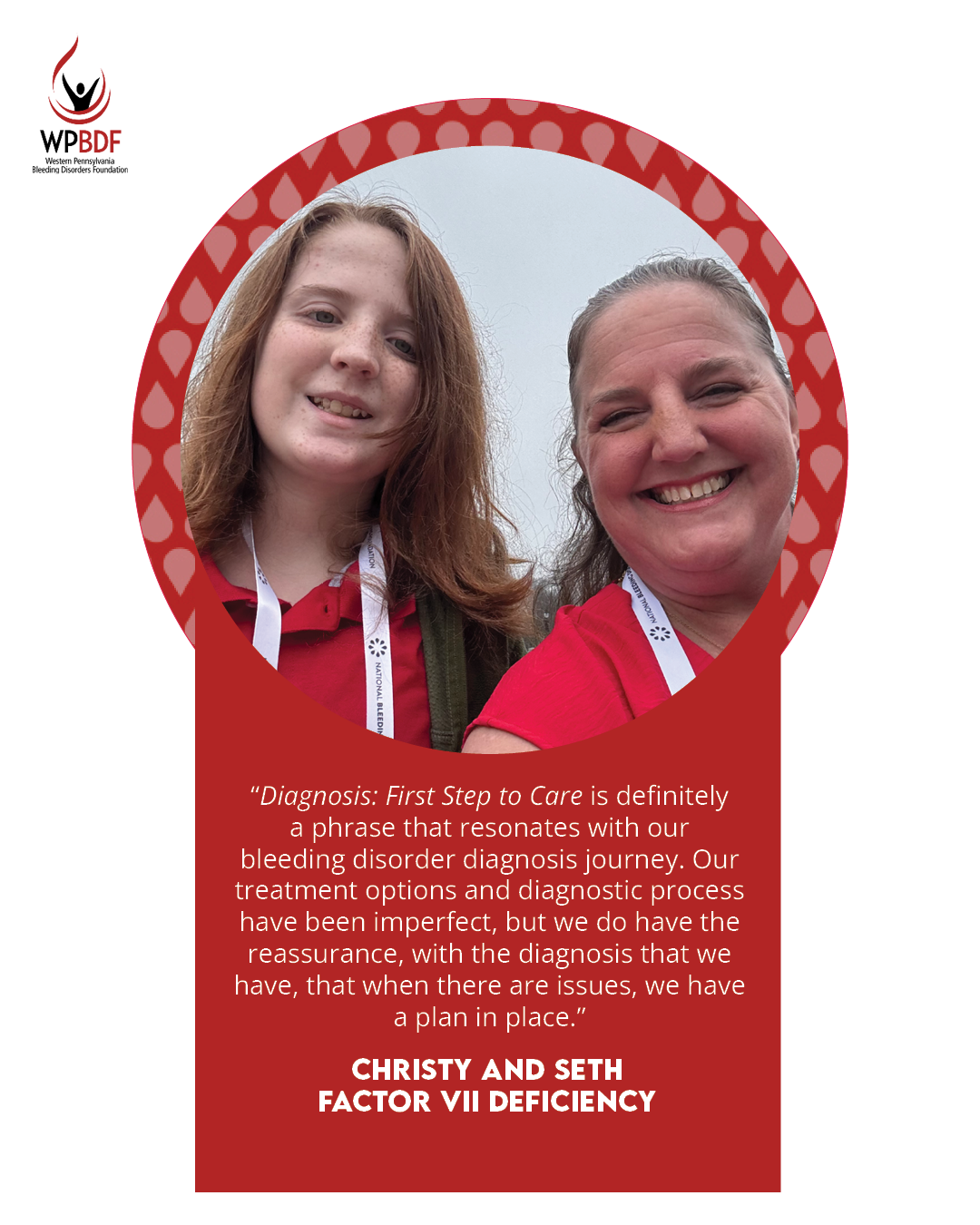
Seth has been a part of the bleeding disorders community for most of his life, but for a long time, it was as a sibling. Two years ago, at the age of 12, Seth finally received his diagnosis of Factor VII deficiency and got answers for his unexplained bruises.
His diagnosis is part of a larger family journey. His mother, Christy, was diagnosed with von Willebrand disease (VWD) in 2007, before having her tonsils removed. Living in rural upstate New York, with no family history and limited knowledge of bleeding disorders, she was certain there had been a mistake.
“When the hematologist in New York called me, he initially told me that he thought I had hemophilia and I laughed at him,” Christy recalls. “I told him there was no possible way – there was no family history, and I was a female. Obviously, I now know that those things don’t matter, but at the time, with the little information that I knew about bleeding disorders, I thought he was off his rocker.”
She was ultimately diagnosed with von Willebrand disease, not hemophilia, but as a young adult, Christy remembers feeling young, dumb, and invincible. She didn’t give her new diagnosis a lot of thought until her first pregnancy when her diagnosis became more relevant.
Christy hemorrhaged during childbirth with Seth. Doctors assured her hemorrhaging was uncommon and it wouldn’t happen again; however, when she had her second child, Xavier, she nearly died. Christy spent several days in the ICU from blood loss and was sent to the HTC for treatment.
“That was when [my bleeding disorder] became a bigger deal to me,” Christy says. “I had severe hemorrhages with each pregnancy which were very scary.”
Aside from Seth and Xavier, Christy and her husband, Jason, have two other children, a boy, Spencer, and a girl, Scarlett. Xavier, Spencer, and Scarlett were eventually diagnosed with VWD and treated as such for many years. With advances in technology and more accurate testing, the family VWD diagnosis was changed to a Platelet Function Disorder diagnosis. Through additional retesting, Christy learned she also had Factor VII deficiency, as well as two of her younger children.
Seth was tested for a bleeding disorder when his younger brother, Xavier, was born and diagnosed. At that time, Christy and Jason didn’t know about the Factor VII deficiency diagnosis, and Seth didn’t have any significant bleeding issues. They didn’t retest him when they found out about their additional diagnosis, but about two years ago, he suddenly started having significant, unexplained bruising.
A minor disagreement with a sibling ended in Seth getting hit, and the resulting bruise was far more severe than expected. For his parents, they thought the issues were related to something else and only did the testing to rule out a bleeding disorder. Christy and Jason got him retested at the Hemophilia Center of Western Pennsylvania (HCWP), and Seth also had the opportunity for additional testing at the OneDrop Conference, hosted by the Comprehensive Health Education Services Foundation, through the American Thrombosis & Hemostasis Network. Finally, at age 12, Seth received his diagnosis of Factor VII deficiency.
For Seth, the news wasn’t frightening. Having grown up surrounded by his siblings and the bleeding disorders community, he knew there were people and resources ready to support him. Just a week after receiving his diagnosis, he attended Camp Hot-to-Clot, a summer camp for children and their siblings affected by bleeding disorders. Seth had gone before as a sibling, but this time was different. This time, he felt like he truly belonged.
“We would not have gotten a diagnosis without care from the Hemophilia Center of Western Pennsylvania,” Christy says. “Even as our diagnoses have evolved, they remain central to our care.”
The family’s experience highlights just how complex bleeding disorders can be. Genetic testing and research are evolving, and variants once classified as “unknown” are now recognized as “presumed positive.” For families like Seth’s, this progress can mean the difference between uncertainty and access to life-saving care.
Support from the Western Pennsylvania Bleeding Disorders Foundation has also been critical, providing education, medical IDs, access to camp, and financial assistance when needed. For Christy, the community is a lifeline.
“The level of education, advocacy, and support in the bleeding disorders community doesn’t exist in the same way for other rare diseases,” she explains.
This Bleeding Disorders Awareness Month, the theme “Diagnosis: The First Step to Care” resonates deeply with Seth’s journey. His diagnosis gave him clarity, access to care, and a sense of belonging.
“Our treatment hasn’t been perfect,” Christy says. “But having a diagnosis means we have a plan. When something happens, we’re not starting from zero. That’s everything for families like ours.”
Seth’s story is a reminder: early testing, access to care, and ongoing research can change lives. And sometimes, new or unexplained symptoms can open the door to answers that make all the difference.
There’s still time to make a difference this Bleeding Disorders Awareness Month! Your gift helps families like Seth’s access the vital programs and services provided by the Western Pennsylvania Bleeding Disorders Foundation. Donate today and ensure that families across Western Pennsylvania have access to the tools and resources they need to navigate life with a bleeding disorder. Donate online at: https://wpbdf.org/donate/