

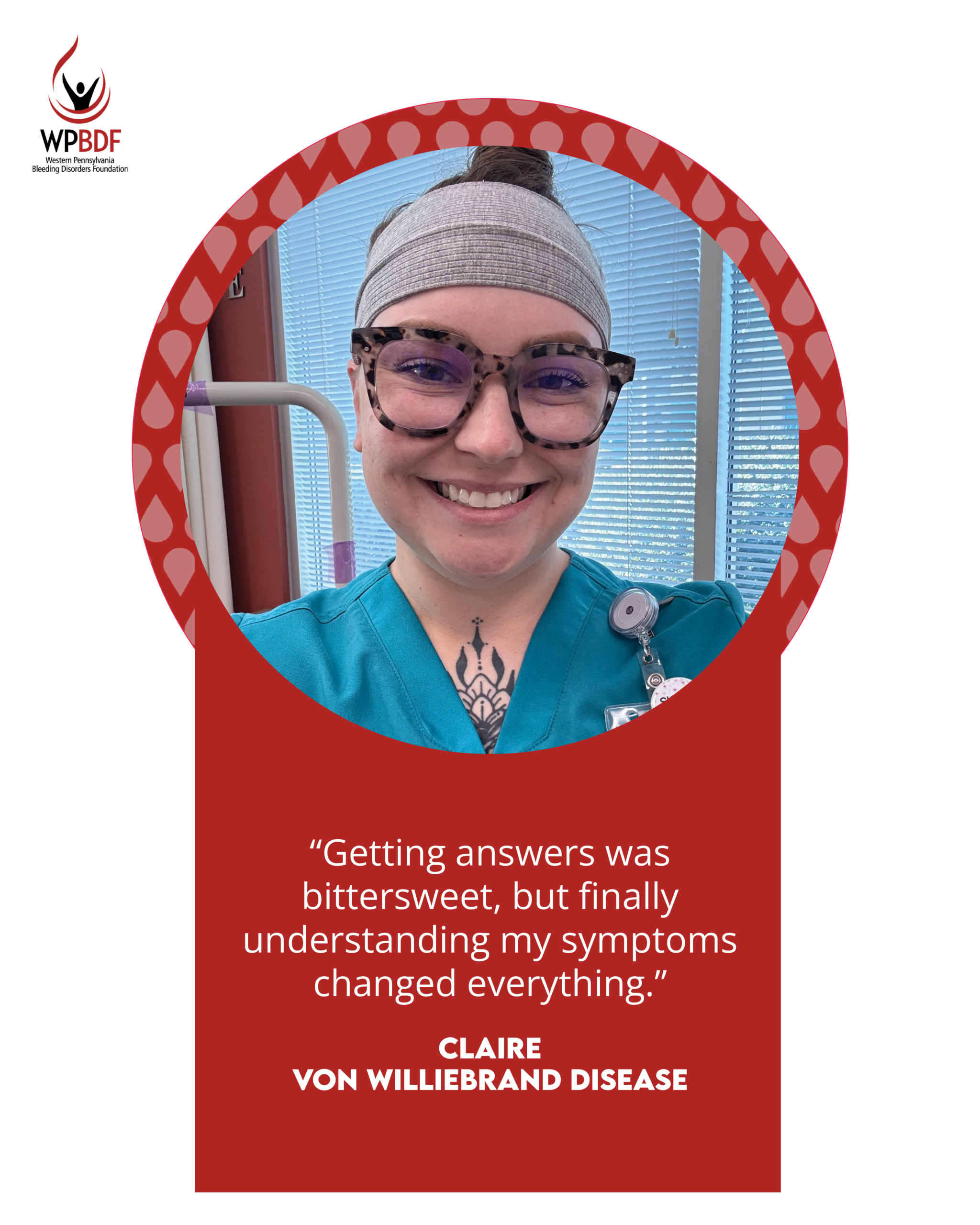
At age 17, Claire’s life was flipped upside down following a tonsillectomy. Following the procedure, she experienced a severe hemorrhage and was ultimately diagnosed with Type 1 von Willebrand Disease (VWD).
The diagnosis brought a flood of questions.
How would this affect her day-to-day? Would she be able to have children in the future? Would it shorten her lifespan? With no family history, and no major life altering medical issues up until this point, the diagnosis was a shock.
“Getting answers was bittersweet. I finally understood the reasoning behind some of my symptoms, but it also meant changing everything I built my life around,” Claire said.
One of Claire’s greatest passions was skiing. In college, she worked as a ski instructor and spent as much time on the slopes as possible. After her diagnosis, however, the increased risk of injury meant she had to give up skiing and other high-risk activities.
Still, Claire refuses to let her bleeding disorder define her life.
She carries a card with her that lists her diagnosis and emergency instructions, and she even has her diagnosis tattooed on her wrist to ensure medical providers have critical information in an emergency.
“My life has evolved since my diagnosis because I have learned to accept it,” she said. “Instead of ignoring it until I’m injured or need surgery, I acknowledge it every day and make decisions that keep me at my healthiest. I am proud to say I have a bleeding disorder. I educate people on my condition and experiences often.”
Claire feels incredibly lucky to have had a knowledgeable hospital team who knew how to test for a bleeding disorder and keep her overnight to monitor her symptoms. As she enters the medical field herself, she is aware that not everyone is lucky enough to have a medical team with the same knowledge and understanding. To her, the biggest barrier to diagnosis is access to care. “Between insurance and out-of-pocket costs, the number of people who can’t even afford a routine doctor visit, let alone a diagnostic test, is astronomical.”
“Another barrier, especially for women, is providers who don’t listen or empathize. Even mild bleeding symptoms are important. My disorder is manageable without daily treatment, but that does not mean my disorder isn’t serious. If I had not hemorrhaged after a routine surgery, I most likely would not have been diagnosed and would most likely have experienced more significant injuries and long-term damage.”
Since her diagnosis in 2011, Claire has become a passionate advocate for the bleeding disorders community. She has traveled to Harrisburg with WPBDF to share her story with legislators, advocated for issues affecting the community, and helped deliver period packs and educational resources to schools across Allegheny County. Her diagnosis empowers her to empower, support, and educate others about bleeding disorders.
Today, Claire is attending dental school and hopes to use both her personal experience and medical training to improve care for people with bleeding disorders.
“I have hope for the future of bleeding disorder awareness and care because of the community I’ve been part of since my diagnosis,” Claire said. “The growth I’ve seen in treatment centers, foundations, and advocacy shows how quickly change can happen when we act.”
For Claire, diagnosis is where everything begins.
“Diagnosis: First Step to Care means finally having answers,” she said. “It’s the moment you realize everything is going to be OK.”