

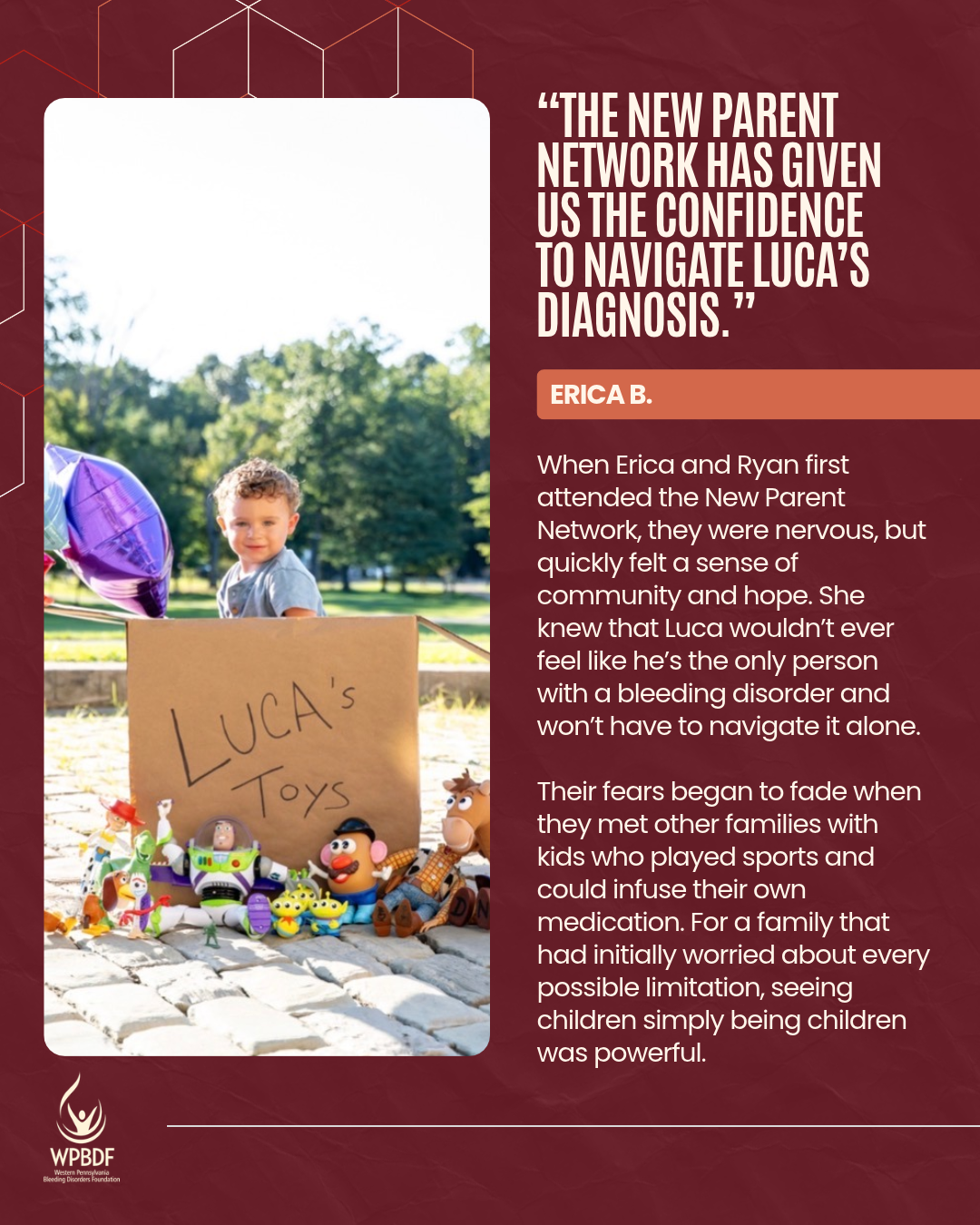
Luca is a busy, adventurous two-year-old who loves being outdoors almost as much as he loves watching the Toy Story movies on repeat. When he’s not playing with his cars and trains, he’s usually shouting “Boo!” and trying to startle whoever is nearby. Along with keeping his mom, Erica, and dad, Ryan, on their toes, he keeps the family dog, Zero, pretty busy, too.
Like any toddler, Luca loves to run, play, and explore the world around him. His parents encourage him to do just that, while keeping a little closer eye on the bumps and tumbles along the way. Luca has hemophilia A, so Erica and Ryan have learned to balance being cautious while giving their son the freedom to simply be a kid.
Still, their journey to feeling comfortable navigating Luca’s diagnosis started with a lot of questions and uncertainty.
After nearly 10 years of trying to have a child, Erica and Ryan began their in vitro fertilization (IVF) journey. During the process, both underwent genetic testing, and Erica discovered she was a carrier of hemophilia A. The news came as a shock, especially since she knew very little about bleeding disorders. She understood that it could be dangerous but didn’t know what living with a bleeding disorder might look like. She had never experienced symptoms that made her suspect she was a carrier, and there was no known family history.
Knowing there was a chance her son could inherit hemophilia was a lot to process and brought difficult emotions for Erica. Even before Luca arrived, Erica and Ryan worried about what a bleeding disorder meant for his future. Would he be able to run and play? Would everyday childhood activities be too risky? Would they have to change the way they raised him?
Erica was already in touch with the Hemophilia Center of Western Pennsylvania (HCWP) before Luca was born, so he received his diagnosis right as they were being discharged from the hospital.
“Once we got the diagnosis, I felt really guilty,” Erica said. “But now, since then, I’ve learned a lot. You can live with hemophilia, and you can live a pretty normal, fulfilling life.”
Their first event was a New Parent Network program at the Children’s Museum in Pittsburgh. Luca was only 9 months old, the youngest kid there. Erica and Ryan were nervous, so they didn’t talk to that many people at first, but she remembers feeling a sense of community and hope.
“I knew then that Luca will not feel like he’s the only person that he knows with a bleeding disorder, and he will not navigate it alone either,” Erica said.
One month later, they attended another New Parent Network program, an overnight weekend event combined with WPBDF’s Education Day at Oglebay. That experience helped change how they pictured their family’s future.
Erica met parents whose children were older, including families with multiple children with bleeding disorders. Hearing about children playing sports, learning to infuse their own factor, and growing up with hemophilia helped her see what might be possible for Luca.
“The families that we were with made me feel so much more normal,” she said. “Another mom was telling me how her kids play sports and infuse their own factor, and it made me feel like Ryan and I can do that, too. We can do it because look at all these other kids and they’re rocking it.”
For a family that had initially worried about every possible limitation, seeing children simply being children was powerful.
“Yes, bleeding disorders are very rare, but to us, even seeing five people who are going through this is comforting, because we see them thriving,” Erica said.
Through the education, resources, and connections Erica and Ryan received through the New Parent Network, they’ve been able to apply that knowledge to real life scenarios as Luca started learning to walk.
Erica recounted a fall Luca had this summer, and she felt like her and her husband were prepared. They knew the signs to watch for and rather than immediately jumping to conclusions, they contacted the treatment center for guidance.
“We called the treatment center, and they said to keep doing what we were already doing. We were very calm, and I don’t think I would have been like that had I not been part of the New Parent Network,” Erica said.
For her, that moment showed just how much had changed. The education and experiences shared through the New Parent Network helped her feel better prepared to navigate an uncertain situation.
“I definitely feel like the New Parent Network made us have the confidence to navigate Luca’s diagnosis,” she said. “Seeing people firsthand, hearing their stories and how they live their lives is really giving us the confidence to raise a child with hemophilia.”
Erica is still learning about her own diagnosis as a carrier and connecting with other women in the bleeding disorders community. She and Ryan continue to find support at WPBDF events, where they can talk with other parents and learn from families at different stages of the journey.
She hopes Luca will grow up feeling comfortable with who he is and confident advocating for himself and others in the bleeding disorders community. Most of all, she wants him to know that his diagnosis doesn’t have to define or limit the life he chooses to live.
Her message to parents who are just beginning their own journey is simple:
“It’s going to be okay. You are going to be okay. Your child is going to be okay. And you’re going to figure it out.”
That reassurance is part of what makes programs like the New Parent Network so important. For families who are suddenly navigating an unfamiliar diagnosis, the right information, resources, and relationships can make a tremendous difference.
“Without these opportunities, families may not know who to turn to, or would rely on the internet for answers,” Erica added. “[This program] gives people that sense of community that they might not have had before.”
Through donor support, WPBDF can continue creating opportunities for families to learn, connect, and see what’s possible beyond the uncertainty of a new diagnosis. The New Parent Network helps parents build knowledge and find encouragement from people who understand their experiences, so they can feel more prepared for the road ahead.
When Erica and Ryan first learned about Luca’s diagnosis, they had so many questions and uncertainties about what the future would hold. Through education, connection, and the support of other families, they’ve gained the knowledge and confidence to help Luca grow up knowing his possibilities are not defined by his diagnosis.
Every family deserves the opportunity to find that same support and encouragement.
This year, you can help empower more possibilities for families affected by bleeding disorders. Your generosity helps WPBDF provide opportunities for families to connect, learn, and find the resources they need to navigate life with a bleeding disorder.
You can empower every possibility. Make your year-end gift today at wpbdf.org/donate.